Electron Linear Accelerator
The Electron Linear Accelerator (LINAC) is a high-power particle accelerator featuring two traveling-wave accelerator tubes. It is distinguished by its use of L-band (1.3 GHz) microwaves, a configuration that is globally rare for a small-scale LINAC. One of the facility’s greatest strengths is the exceptional versatility of its beam parameters. It can generate electron beams with energies ranging from 6 to 46 MeV, pulse widths from 2 ns to 5 μ, and repetition rates from 1 to 360 Hz. The system is also capable of producing single-bunch beams. With a maximum beam power of 10 kW (e.g., 30 MeV, 500 mA, 4 μ pulse width at 180 Hz), it delivers some of the highest current levels in Japan for a compact LINAC. Since its establishment in 1965 as a pulsed neutron source, the facility has evolved into a versatile quantum beam generator. It currently supports a diverse range of research fields using electrons, X-rays, neutrons, and low-energy positrons. Key applications include:
- Material Science: Material irradiation and characterization.
- Nuclear Engineering: Nuclear data acquisition via neutron time-of-flight (TOF) analysis and RI production through (γ , n)and (γ, p) reactions.
- Advanced Spectroscopy: Spectroscopy experiments using Terahertz (THz) coherent radiation.
- Instrumentation Development: Radiation detector development using ultra-weak beams generated by microwave field emission within the accelerator tubes.
- Medical Physics: Fundamental research into FLASH radiotherapy (ultra-high dose rate cancer treatment).
The facility serves as a vital hub for the Joint Usage/Research Center, hosting projects selected from across Japan, while also playing a crucial role in the education and training of Kyoto University graduate students.
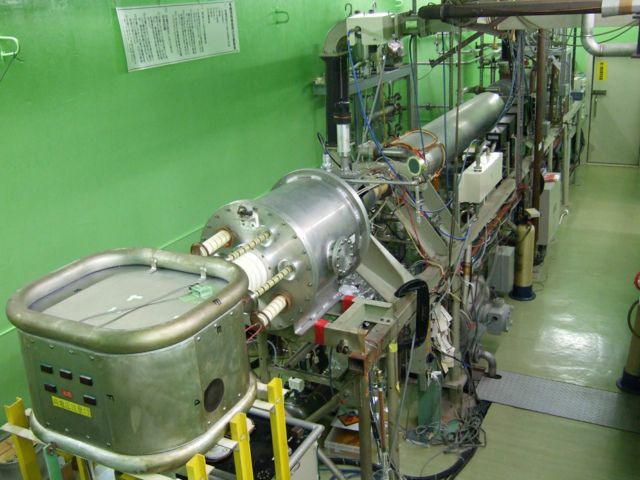
Electron Linear Accelerator